
Three measurements, one box, one pole.
Traffic, particulate and noise are usually three procurements, three suppliers and three portals. Here they are one device with its own connection, which can go up wherever there is a pole and a mains supply.
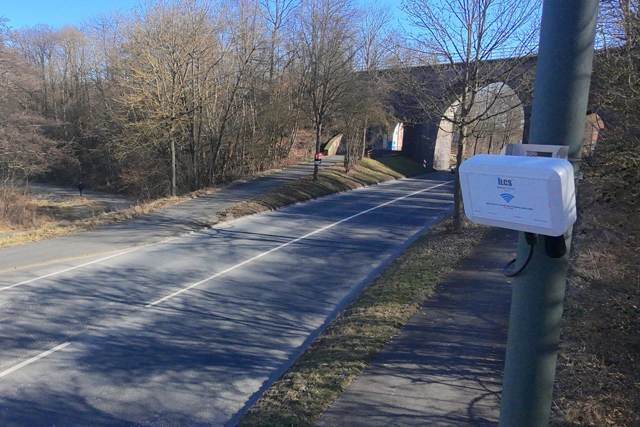
SensorBox on a road — installed site
What it measures.
Enough to answer the three questions a municipality is usually asked about a street at the same time.
Traffic
Radar counting and classification of vehicles — how many, how fast, in which direction — without a camera and without recording anyone.
Air quality
Particulate from PM1 to PM10, with temperature and humidity, at the height where people actually breathe it.
Noise
Sound level over time, next to the traffic count that explains it — which is what makes a complaint answerable.
It does not need our network to work.
The box has its own eSIM, so it can be installed on a street that has no iLCS lighting — as a first project, as a measurement campaign before a traffic scheme, or to answer a specific complaint about a specific road.
Where the lighting network does exist, the readings sit next to it in the same platform, on the same map, with the same export.
Environment & air quality →| Specification | |
|---|---|
| Measurements | Radar traffic; particulate PM1, PM2.5, PM4, PM10; noise; temperature and humidity |
| Connectivity | eSIM, direct to the platform — no gateway required |
| Supply | 85 … 264 V AC, with a LiFePO₄ backup |
| Mounting | Pole bracket, outdoor |
| Privacy | Radar, not video: nothing identifiable is captured or transmitted |
Datasheet v0.3 · full document, including the particulate sensor's own specification, on request.
Which street would you measure first?
A single box on a contested road, for a season, usually settles an argument that has been running for years.