Analysis, invention, measurement — in that order.
First a study of why adaptive lighting needs a network of a particular kind. Then a patent on the way traffic becomes an allowed lighting class. Then, five years later, the measurement of what it produced in the field. All of it published, and open access.
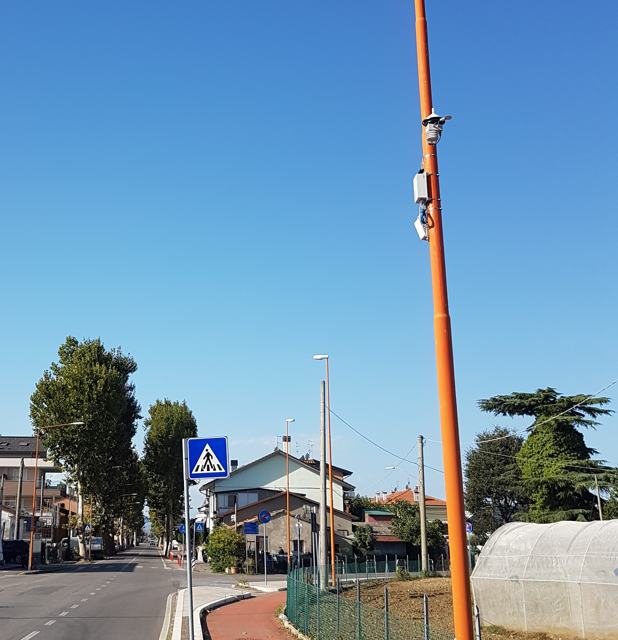
One of the measured installations — installed site
Two papers.
Comprehensive Assessment of Context-Adaptive Street Lighting: Technical Aspects, Economic Insights, and Measurements from Large-Scale, Long-Term Implementations
Pasolini G., Toppan P., Toppan A., Bandiera R., Mirabella M., Zabini F., Bonata D., Andrisano O. — Sensors 24(18):5942, September 2024.
University of Bologna (DEI and Architecture), CNIT WiLab, Wi4B, AstroLight Studio.
Field measurements from three full-adaptive installations against the same LED luminaires on an astronomical clock; a comparison of adaptive operation with virtual-midnight profiles and motion sensing on real traffic data; the economics, and the network architecture the system runs on.
DOI 10.3390/s24185942 — open access →Design, Deployment and Evolution of Heterogeneous Smart Public Lighting Systems
Pasolini G., Toppan P., Zabini F., De Castro C., Andrisano O. — Applied Sciences 9(16):3281, August 2019.
CNIT WiLab and University of Bologna (DEI), Wi4B, IEIIT-CNR.
A comparison of the networks used for public lighting — power-line, cellular, LoRaWAN, Sigfox, 802.15.4 mesh — against what real-time control actually requires. Its conclusion is the reason iLCS has its own mesh: low-power wide-area networks were not conceived for real-time communication, and per-device subscriptions consume the saving the system is meant to produce.
DOI 10.3390/app9163281 — open access →It is the analysis that came before the product — and the reason we can explain the network choice with an argument rather than a preference.
The mesh network →Adaptive street lighting system.
The patent covers the method that turns measured traffic into the lighting class an installation is allowed to apply — the step between the sensor and the dimming command.
Granted in Italy — IT 102021000031628
European and US patents pending.
We write "granted in Italy, pending elsewhere" rather than "patented", because those are different things and a technical reader knows it.
Performance claims, with a method behind them.
Every performance figure is compared against a clearly defined baseline. For adaptive lighting, we use the same LED luminaires operating on an astronomical clock — separating the savings generated by adaptive control from those achieved by the transition from conventional lighting to LED.
We distinguish between energy consumption measured directly in real installations and results calculated from real traffic and operating data. The methodology behind each figure is stated alongside the results.
Our field results and measurement methodology have been published in peer-reviewed, open-access scientific papers. The datasets, assumptions and calculation methods are documented so that the results can be understood, assessed and reproduced.
Academic roots. Engineering in-house.
Wi4B was founded by researchers with decades of work in wireless communications at the University of Bologna and CNIT WiLab. iLCS is designed, written and maintained inside the company — and the standing relationship with that research community is what keeps the methods under scrutiny.
From research to engineering
Decades of research in wireless communications, networking and distributed systems are the background the company was founded on. That expertise is applied inside Wi4B, to the platform and to the devices in the field.
Academic collaboration
An active relationship with researchers at the University of Bologna and CNIT WiLab: scientific investigation, experimental measurement and the study of systems already in service — how technology behaves outside the laboratory, and what it does to real infrastructure.
Published. Measured. Verifiable.
Joint publications examine iLCS installations with experimental data and a reproducible method. Not simulations or expected performance: communication behaviour, control strategy, energy consumption and the measured effect of adaptive operation.
The technology is developed by Wi4B. Its results can be measured in the field.
Want to take a closer look at the methodology?
Both papers are open access, and the people who wrote them work here. Send the question and it reaches them.