
The case that halves our own headline number.
Nearly three thousand luminaires on residential roads at classes M4 and M5. Measured against the same LEDs on an astronomical clock, full adaptive operation returned 24.6 % — about half of what the same system measured on main roads. We publish it because it is the number most cities will actually get on most of their streets.
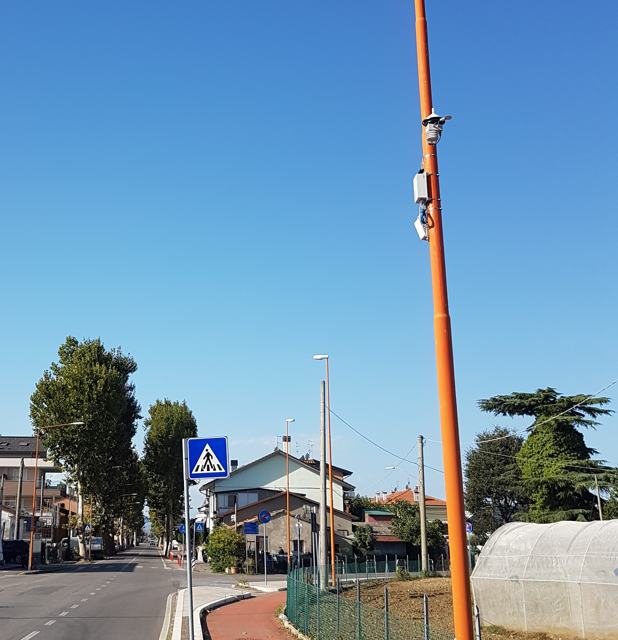
Residential network under adaptive control — installed site
There is less room above the minimum.
A main road designed for class M3 has 1.00 cd/m² to work with, and the standard allows it to fall several classes when the traffic justifies it. A residential road designed for M5 starts at 0.50 cd/m² and has M6 — 0.30 — below it. The ceiling is lower, so the saving is smaller. It is arithmetic, not performance.
This is the single most useful thing to understand before building a business case for a whole city. The kilometres that produce the large percentages are a small part of a municipal network; the majority of the points are residential, and they behave like this one.
How the mix is built →The distance between the design class and the lowest allowed class is the whole opportunity. On a residential road it is short.
A quarter of the bill, on three thousand points.
Twenty-four per cent of a large number is a large number — and on a residential network the control layer brings things that matter as much as the energy.
Faults, not complaints
Three thousand points reporting their own state: the morning list replaces the phone calls, which on residential streets is where the operating cost sits.
A class that is provable
Every reduction stored with the measurement that justified it — on exactly the streets where residents ask why the light is lower.
Dependent roads
Side roads take their class from the main road they join, so a whole district can be run adaptively from a handful of instrumented stretches.
The three published installations.
Same method, same baseline, same study. The spread between them is the honest range to plan with.
Pasolini et al., Sensors 24(18):5942, 2024 — with the University of Bologna and CNIT; Wi4B researchers among the authors, conflict of interest declared.
Take the class of each stretch, its length and its traffic profile. The business case is the sum of those, not one percentage applied to a whole network.
Sensors go on the stretches that justify them. The rest of the network gets control, which costs less and still returns visibility and maintenance savings.
Ask us for the unflattering number for your network.
Send the inventory with the classes. You will get a stretch-by-stretch estimate, including the kilometres where we would advise control rather than sensors.