
Measure the air where people actually breathe it.
Regional monitoring stations are few, expensive and far from the street that residents are complaining about. A pole in that street already has power, height and a network — which is most of what an air quality measurement needs.
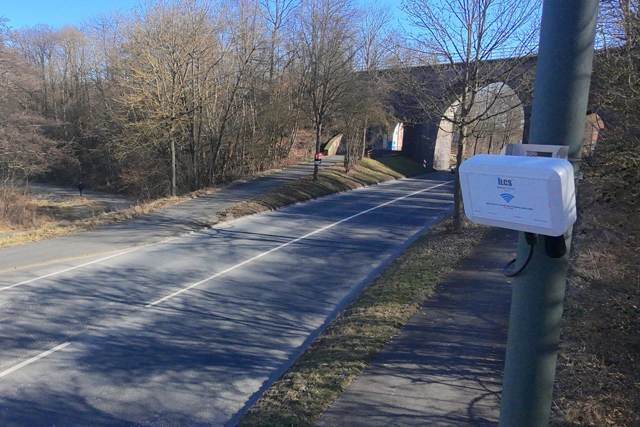
Air quality, noise and traffic node — installed site
A complaint about a street cannot be answered with a regional average.
And by the time a mobile campaign is organised, the season, the traffic and the argument have all changed.
Too few points
One station for a city says nothing about the road with the school on it.
Campaigns, not series
A two-week measurement cannot show a trend, a season or the effect of a change.
Numbers without a cause
Particulate without a traffic count next to it explains nothing and convinces nobody.
What runs, and on what.
Available means it runs today on our own devices. Integrable means a third-party sensor we have already connected, qualified per site. We print the label rather than blurring the two.
A sensor on a pole, and the network that is already in the street.
Outdoor devices ride the lighting mesh or use their own eSIM where there is no network. Indoor sensors come in over LoRaWAN. Everything lands in one history with a place, a time and a unit.
No new infrastructure
Power, height and coverage come from the pole. That is the difference between a sensor and a project.
One map
Air, noise, traffic and lighting on the same map and in the same export — not four portals.
Open data ready
Standard export formats, so a municipality can publish the series it is measuring.
We have air quality and weather monitoring running on installed sites in Europe and South-East Asia. We publish no percentages here: measuring air is about producing a defensible series, not about a saving.
Ask for a reference →Which street is the argument about?
One box, one season, and the discussion moves from opinions to a series anyone can read.