
Every kilowatt-hour explained — by line, by section, by tenant.
An invoice tells you what you spent. It does not tell you which line, which building or which shift spent it, and it tells you two months late. Measuring where the energy is consumed changes both.
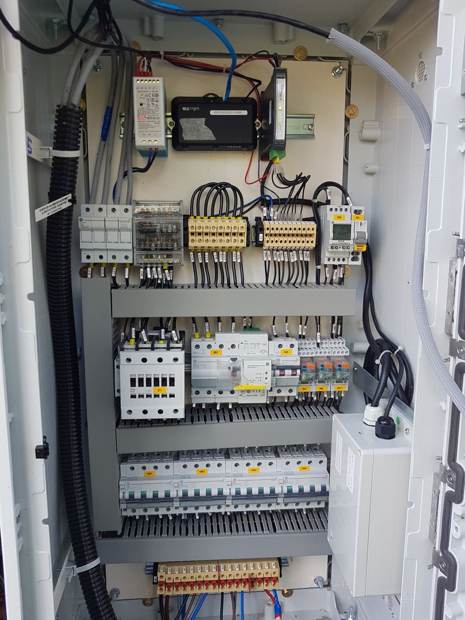
Metering on the rail, next to the protections — installed site
Three questions the bill cannot answer.
They are the reason energy managers keep spreadsheets that are already out of date when they are opened.
Which line is drifting?
A single section can absorb a rise that stays invisible in the total until the year-end comparison.
Who should pay for it?
Tenants, departments and shared services usually get a percentage, not a measurement.
When did it start?
Without an hourly history there is no way to tie a rise to the week, the machine or the setting that caused it.
Real quantities, from meters that carry a certificate.
The controller in the cabinet reads third-party MID meters over RS-485 and sends the readings on. Nothing is inferred, estimated or spread across a formula.
Where the line cannot be opened, the meters are fitted with split-core current transformers — 40, 63, 250 or 400 A — clamped around the existing conductors. The cabinet keeps running while it is being instrumented.
Water, gas and heat meters, photovoltaic inverters, storage and charging points are brought in through Modbus, pulse inputs or LoRaWAN, and land in the same history. These are integrations, configured per site — we say so, rather than listing them as if they were ours.
Four people, four reasons.
The measurement is the same. What changes is the document it has to produce at the end of the month.
Energy manager
Finds the drift while it is still a drift, and can prove what an intervention changed.
Facility & real estate
Allocates cost per tenant or per system on a measurement, not on a share of floor area.
ESCO / EPC
Has an hourly series per measured point — the raw material of any verification of savings.
Public technical office
Produces the periodic reporting from the system that took the readings, not by retyping bills.
We publish no percentage for metering. Measuring does not save energy by itself — it tells you where to act, and then lets you prove what the action was worth. The savings we do publish come from adaptive lighting, where we measured them.
See measured results →Send us a single-line diagram.
The lines you want measured and the space left on the rail are enough for us to propose the meters, the CTs and the number of controllers.