
Large areas, high masts, and a procurement that checks everything.
Airports and ports light enormous surfaces from few, very tall structures, run around the clock, and ask questions no municipality asks: about radio emissions, about failure modes, about what happens when the network is gone.
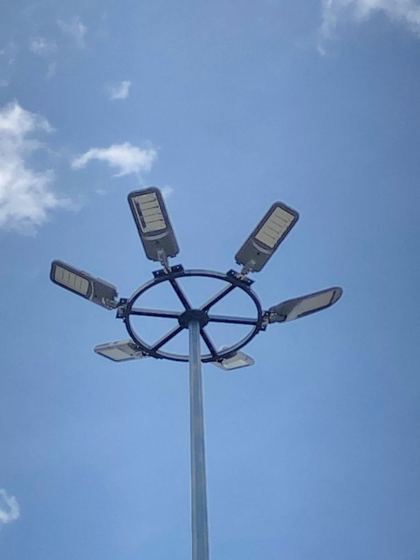
High mast over an operational area — installed site
What makes these sites different.
The lighting problem is ordinary. The constraints around it are not.
Emissions are scrutinised
Anything transmitting near navigation and radar systems has to justify itself with measurements, not datasheets.
Failure modes matter more than features
The question is never what it does; it is what happens when something breaks.
How it works →Every visit is an escort
Maintenance on the airside costs hours of procedure, so a fault that announces itself is worth more here than anywhere.
Few masts, many luminaires
Tens of fittings on one structure, and switchgear that runs an area rather than a street.
Cabinet control →Low emitted power, and a report to hand over.
Our luminaire node has been characterised by an independent laboratory, and the emitted power is low by design: the mesh works through many short hops rather than a few long-range transmissions. The test reports, not a marketing figure, are what an airport's technical review wants to read — and they are part of what we hand over.
EN 300 328, EN 301 489-1 / -17, EN 55032 / 55035, EN 62479 / EN 50663, EN 62368-1, with third-party test reports.
A mesh of many short hops, rather than few long-range transmissions — which is also why the emission per device is small.
The field network is the site's own: nothing depends on a public cellular service inside the perimeter.
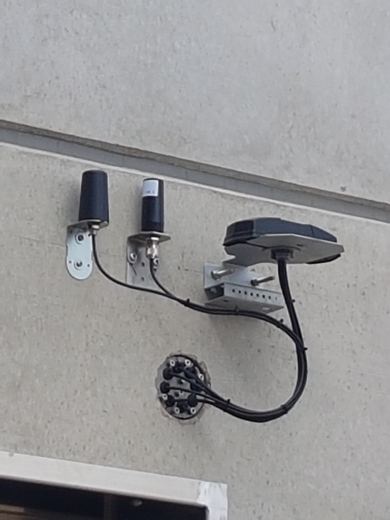
Site gateway — installed site
It keeps working when the link does not.
Schedules, levels, presence reactions and safety fallbacks are decided in the field. A network outage or a platform maintenance window is a gap in the data, not in the lighting of an apron or a yard.
Fail-safe by default
Node, sensor or network failure returns the area to its design level. A dark surface is never a fallback.
On-premise if required
The platform can run inside the perimeter, with nothing leaving the site.
Faults before the escort
Failures reported per luminaire, so an airside visit is planned with the right parts and the right access.
We have taken part in airport and port procurements and have installations in these environments. Site names and figures are not published here — references on request, together with the device test reports.
Ask for a reference →Send the constraint list first.
Radio limits, access rules, continuity requirements and what may leave the perimeter. The lighting design is the easy part once those are clear.