
iLCS Sentinel
A plug-and-play edge controller on the DIN rail. It reads the meters, watches the protections, drives the contactors, and keeps doing all three when the connection is gone.
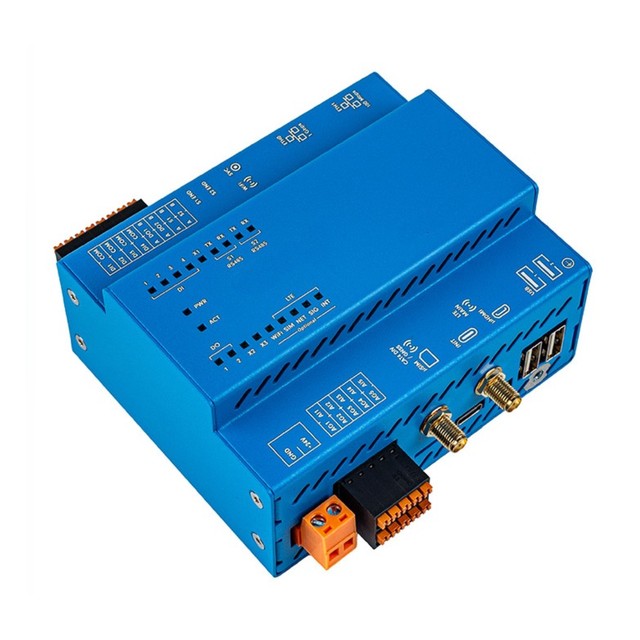
iLCS Sentinel — DIN-rail edge controller
What it is for.
Feeder pillars, technical cabinets and plant switchboards — anywhere a person currently has to open a door to know what is happening.
Energy, power, voltage, current and cos φ per line, from MID-certified meters on the RS-485 bus.
Main breaker, mains loss, RCD trip, phase loss, consumption over threshold, door opening — time-stamped.
Breakers and contactors, from the platform or on an astronomical calendar, with local lock-out on site.
Autonomous logic, hardware watchdog and an optional battery that reports the black-out itself.
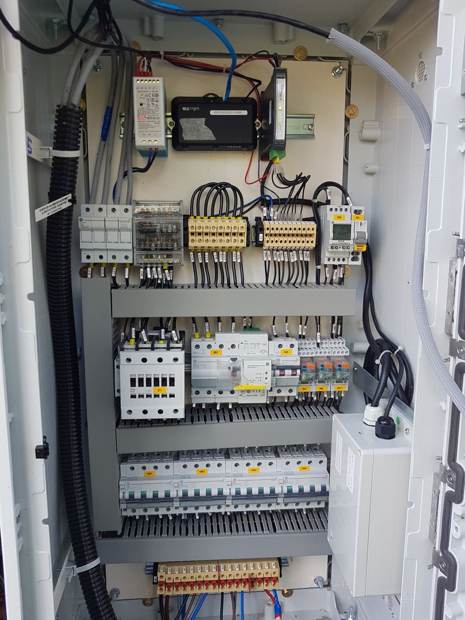
Inside a controlled cabinet — installed site
Technical specification
Datasheet v1.02 · full document on request| Compute & security | |
|---|---|
| Processor | Quad-core Arm Cortex-A72, up to 1.5 GHz |
| Memory | 1 GB LPDDR4 (8 GB option) |
| Storage | 8 GB eMMC (32 GB option) |
| Operating system | Hardened Linux, signed firmware |
| Hardware security | TPM 2.x, hardware watchdog |
| Real-time clock | CR2032 lithium cell, ≈10 years |
| Communication | |
|---|---|
| Ethernet | 1 × 1 Gbps |
| Serial | 2 × RS-485, isolated, 50 … 3,000,000 baud, switchable 120 Ω termination |
| Cellular (option) | LTE Cat 1 with GNSS — GPS, GLONASS, BeiDou, Galileo, QZSS |
| LTE bands (option) | FDD B1/3/4/7/8/20/28 · TDD B38/40/41 · GSM/GPRS/EDGE |
| WLAN (option) | Wi-Fi 802.11 b/g/n/ac 2.4 / 5 GHz, Bluetooth 5.0 LE |
| iLCS mesh (option) | 2.4 GHz ISM, 16 channels, +20 dBm within regional limits — the unit then acts as the cluster gateway for the luminaires within reach, whichever circuits feed them |
| Antennas | SMA connectors, so the antennas can be taken outside the cabinet where the enclosure is in the way |
| Digital inputs | |
|---|---|
| Channels | 4, sink type, one common, galvanically isolated, LED per channel |
| Levels | Logic 0 < 5 V DC · logic 1 > 9 V DC · 35 V DC maximum |
| Input resistance | 6,200 Ω at logic 1 |
| Minimum pulse | 20 µs — typical delay 20 µs (0→1) / 60 µs (1→0) |
| Counter | Up to 10 kHz, with retained count |
| Digital outputs | |
|---|---|
| Channels | 2, MOSFET solid-state, galvanically isolated, LED per channel |
| Rating | 48 V DC, 500 mA continuous · 1.5 A pulse · 6 A short-circuit peak |
| Load type | Resistive — inductive loads need an external snubber |
| Power & mechanics | |
|---|---|
| Supply | 24 V DC SELV recommended · absolute limits 10.2 … 32.2 V DC · reverse-polarity protected |
| Current at 24 V | 0.25 A typical with LTE (1 A max) · 0.18 A without (0.7 A max) |
| Backup battery (option) | Li-ion 14 Wh, ≈1 h autonomy — sized for reporting the outage, not for riding it out |
| Dimensions | 108 × 90 × 56 mm |
| Mounting | 35 mm DIN rail, EN 60715 — bracket and screws included |
| Terminals | Pluggable · power 0.75–2.5 mm² (5.08 mm pitch) · signals 0.2–1.5 mm² (3.5 mm pitch) |
Two things worth knowing before you specify it.
Sentinel reads MID-certified three-phase meters over RS-485; it is the meter that carries the certificate. Where a local approval is required — for example India's IS 16444 — the meter has to satisfy it, and we will say so rather than imply otherwise.
There is no DALI or D4i port: dimming a single luminaire is the job of the node on the pole. Sentinel and the luminaire nodes are complementary, and in a mesh installation the same unit can also act as the cluster gateway.
EMC, RED, RoHS and WEEE. Test reports, environmental ratings and ingress protection on request — we would rather send you the document than print a claim.
What the cabinet looks like once it is connected.
One map, a history per line, alarms that reach the people on call, and reports that leave as PDF or Excel on a schedule.
Map & status
Every cabinet located at installation by GNSS, with its live state.
Event history
Who commanded what, when a protection tripped, when a door opened.
Scheduled reports
Daily, weekly or monthly, per line and per site.
Open interfaces
APIs and standard protocols towards your own systems.
Send us a photo of the inside of one cabinet.
Lines, meters and protections are usually enough for us to say what can be measured, what can be switched, and how many units you need.