
Adaptive lighting is written down. Use that.
There is a normative way to reduce a lighting class, and a normative way to prove it was allowed. A system that follows it can be specified, inspected and defended — which is worth more in a tender than any percentage.
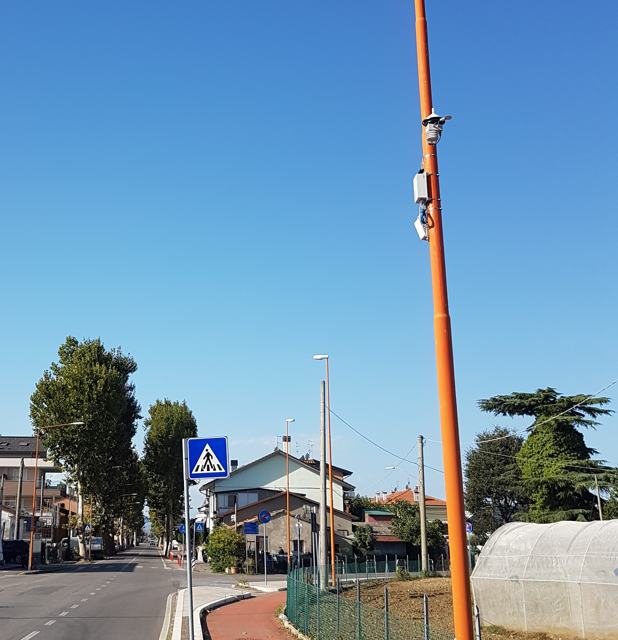
Measurement on the stretch — installed site
TAI and FAI are not marketing words.
They are defined in UNI 11248 — the Italian standard that applies the class-selection criteria of CEN/TR 13201-1 — and they differ in what is measured and in how far the class may fall.
| TAI — traffic adaptive | FAI — full adaptive | |
|---|---|---|
| What is measured | Traffic flow on the stretch | Traffic flow, road surface luminance and weather |
| How it regulates | In steps, from one class to the next | Continuously, closed loop on the measured luminance |
| Maximum reduction | Two classes — one at 50 % of maximum flow, two at 25 % | Up to three classes below the design class |
| Compensates driver and surface | No | Yes — it measures the light that is actually on the road |
| On failure | Return to the design class. The standard requires it, and it is the direction that costs energy rather than safety. | |
The classes themselves carry the luminance requirement: M3 is 1.00 cd/m², M4 0.75, M5 0.50, M6 0.30. This is why a reduction is expressed in classes and not in a percentage of power — the percentage depends on the luminaire, the class does not.
What each standard governs.
Four references cover almost every question an adaptive project raises.
CEN/TR 13201-1
How a road gets its lighting class in the first place, from traffic, layout and surroundings. Currently under revision, with a section on adaptive lighting.
EN 13201-2
The performance requirements per class: luminance or illuminance, uniformity, glare. The numbers an inspection checks against.
EN 13201-4
How the installation is measured once built — including the luminance measurement method our full-adaptive loop relies on.
UNI 11248
Defines TAI and FAI, the conditions for reducing the operating class and the required behaviour on failure. Appendix D is the operative part.
Reaction time is a criterion, not a detail.
Italian minimum environmental criteria for public lighting reward systems able to react to a change in conditions within a minute. It is a quiet but decisive line: a schedule-based system cannot meet it, because it does not know that conditions changed.
Regional rules still apply.
Several Italian regions set their own limits on upward light and on operating regimes. Adaptive operation generally helps — it reduces emitted light when the road is empty — but the design has to satisfy the regional rule as well as the national standard, and we check which one applies before proposing a class profile.
What the hardware carries.
Radio, electromagnetic compatibility and electrical safety for the field devices, with test reports available on request.
Radio
EN 300 328 for the 2.4 GHz band, under the Radio Equipment Directive.
EMC
EN 301 489-1 / -17, EN 55032 and EN 55035, EN 61000-3-2 / -3-3.
Exposure & safety
EN 62479 / EN 50663 for RF exposure, EN 62368-1 for electrical safety.
Directives
CE marking under RED, EMC, RoHS and WEEE, per product family.
Metering certification belongs to the meter: where MID-certified measurement is required, it is the third-party meter that carries the certificate, and we name the model in the offer rather than writing “certified metering” and leaving it there.
Security →Writing the technical clauses?
The specification pack turns this page into text you can paste — with the six clauses that separate a real adaptive requirement from a dimming calendar.