
One network, many services.
The network that runs the lights is already on every street and inside every site, with power and a place to mount things. Adding a service is adding a sensor — not building another system.
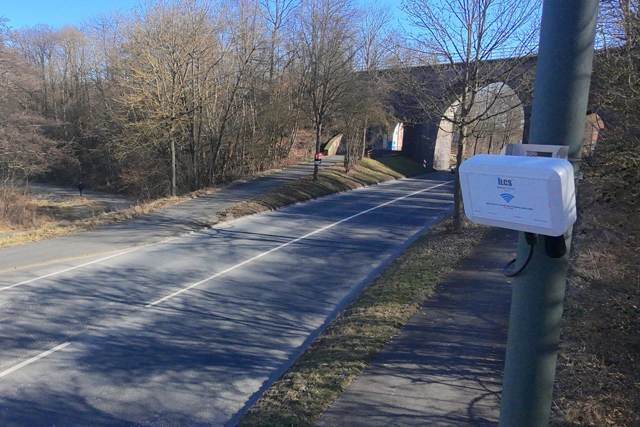
Air quality, noise and traffic node — installed site, Germany
Every new service usually means a new island.
Its own sensors, its own SIM cards, its own portal, its own contract — and data that never meets the rest. The alternative is to reuse what is already in the street.
Power and poles
Mains at the right height, on assets you own, in the places that matter.
A radio network
The mesh covers the stretch; adding a device is adding a node, not a subscription.
A platform
One map, one history, one set of alarms and one export — however many services run.
Six areas, and an honest label on each service.
A service is available when it runs today on our devices, and integrable when it needs a third-party sensor we have already worked with. We say which is which.
Environment & air quality
Particulate, noise, temperature, humidity and traffic on the pole you already own — the same box that helps the lighting decide.
Open →Water & flooding
Levels in basins and channels, pump status, alarms that reach the people on call before the water reaches the road.
Open →Safety & occupancy
Presence, access and events tied to what the lighting already knows — including light that comes up where someone is walking.
Open →Mobility & parking
Traffic counts by class of vehicle, outdoor parking occupancy, charging points seen from the same platform.
Open →Building operations
Indoor lighting, HVAC signals, sub-meters and technical alarms, with the same controllers used in the street cabinets.
Open →Energy & utility metering
Electricity, water and gas read where they are consumed, with the cabinet as the point of measurement.
Open →Our devices first, third-party devices welcome.
The platform takes data from iLCS devices, from Modbus equipment in the cabinets and from LoRaWAN sensors, and normalises it. Nothing forces you into our catalogue.
One data model
Every measurement lands with a place, a time and a unit — and leaves in a standard format.
Alarms that reach people
Thresholds, escalation and notifications, with the history to show what happened.
Open interfaces
APIs and standard protocols towards your GIS, your BMS or your city platform.
Cases with published numbers for this pillar are still being built: today we show what runs, where, and on which devices — not percentages we cannot back.
Projects →