
Know what every luminaire is doing. Then decide.
Before a network can adapt, it has to be visible. One node per luminaire gives you the state, the consumption and the faults of each point — and the ability to change what it does without sending a van.
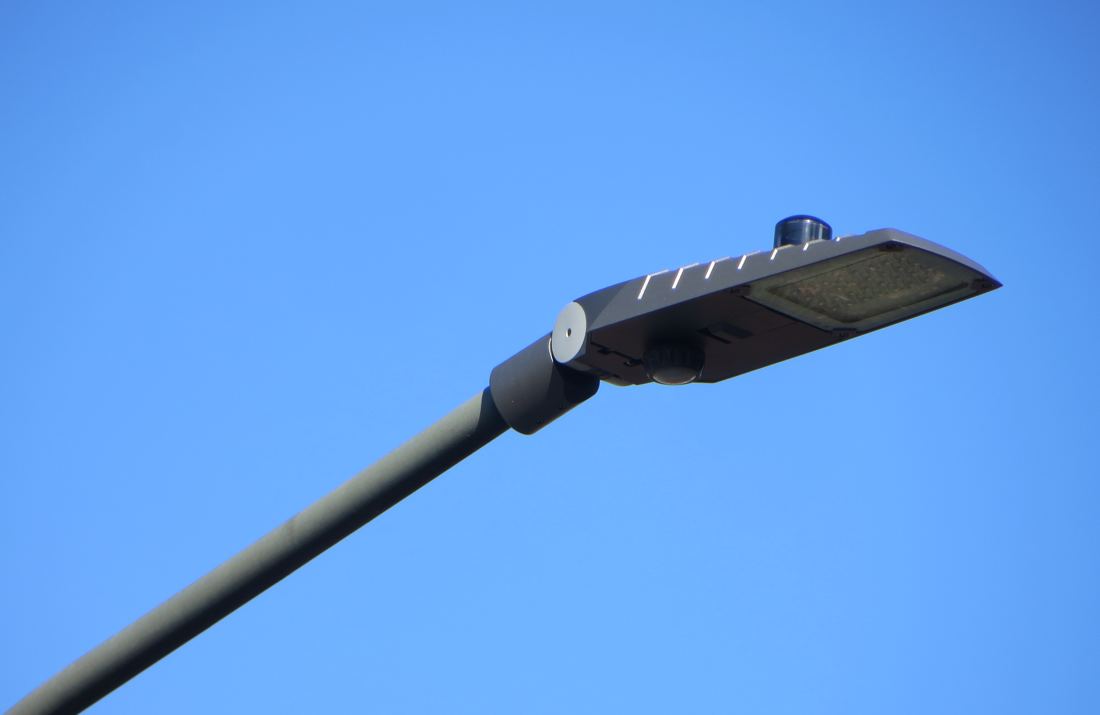
Control node on the luminaire — installed site
The three things a network without control cannot tell you.
And that no amount of good intention in the maintenance contract can fix.
Which lamps are out tonight
Today the answer comes from residents, from a night patrol, or from nobody at all.
Where the consumption sits
The bill is per cabinet. The waste is per luminaire, per hour, and invisible at that level.
What you actually own
Inventories drift: poles move, luminaires get replaced, and the spreadsheet stays where it was.
One node per luminaire, and a platform that speaks for all of them.
The node sits on the Zhaga Book 18 or NEMA socket, or inside the luminaire for indoor and retrofit, and drives the driver over DALI-2 / D4i or 0–10 V.
The morning list replaces the phone call. Failed points arrive with their position and their history, so a van leaves with a route and a spare part instead of an address and a guess. Over a season this is usually worth more than the energy.
About six gateways carry a thousand luminaires. There is no SIM card and no subscription attached to each point — which over the fifteen years of a concession is the difference between a system and a recurring bill.
Per-luminaire energy and diagnostics need D4i drivers (DALI parts 150 / 250 / 251 / 252 / 253). With older drivers you still get control and 0–10 V dimming, but the measurement comes from the node rather than from the driver. We check this against your luminaire list before quoting.
Control first, adaptive where it pays.
Control is the layer that makes the rest possible, and the one that covers the whole network. Adaptive operation is then added on the stretches where the class and the traffic justify sensors — on the same nodes, with a configuration change and a few devices per stretch.
Nothing is thrown away
The nodes installed for control are the nodes that run adaptive lighting later.
The evidence follows
Once energy is measured per luminaire and per hour, any change you make can be proved — including somebody else's.
The rest of the street joins
Cabinets and city services ride the same mesh, so the second project costs far less than the first.
Send us the luminaire list.
Models, drivers and where they are. We will say which nodes fit, how many gateways the layout needs, and what can be measured with the drivers you already have.